Showing posts with label traditional watercolor style. Show all posts

Friday, June 20, 2014

RISD Weekend Watercolor Intensive, Summer 2014


I had a grand time with 13 fabulous students last weekend. They were all ready to spend a weekend learning more about watercolor. After a full day of exercises on Saturday, they painted their own pieces on Sunday. Here is one of the student paintings, a class portrait.

A painting of the class in action done by student, Susan Klare.
 Below are pictures of most of the students, with their work in progress.

Susan and  Whitney came for some artistic mom-daughter together time.
Ben (how did I miss getting a picture of Ben!) drove up from DC for the weekend.
Several of the students enjoyed Waterfires after class on Saturday evening.

Whitney is building up courage to add layers of paint.

Here is an early stage of Susan's class portrait.
Jane worked diligently on color swatches


Cheryl did a lovely scene of rocks, water and flowers.

Birch used resist techniques, and mixed red and green... complementary colors... to get his dark background.
Lowry originally hoped for an absolutely flat sky, but her delicate clouds turned out even better.


Lynn did a painting of her grandparent's farm.
Alessandra took a break from law school to do several paintings.

Anna, our best equipped student, added energy to the weekend.


The students had a wide range of backgrounds... from total beginners, to people who had some experience with watercolor but wanted to learn more, to experienced artists who were looking to learn another media.

Ben experimented with wet-on-wet and Yupo paper, and Miyoung created textured backgrounds with salt. Anne did a floral still life from a blooming kalanchoe. Lois worked on letterforms with delicate colors that she later planned to layer, overpaint, and even stitch into art pieces.

We had a photographer spend a few hours with us, so pictures of the class will probably show up in future RISD CE catalogs.

Thanks to all of the students for your creativity and enthusiasm! It was an exciting and fun weekend for me!

Monday, January 6, 2014

Illustration Friday 2014, and Happy New Year!

A Happy and Joyous New Year to All!

This week's Illustration Friday has the prompt word: "TIME." How appropriate for a new year.

I'm floating on the automatic high of "starting fresh," as I do every January. Still, I'm posting an old piece... "Time Passes." Although it's remains one of my favorites, it is 13 years old! Perhaps I'll do an update in a decade or two!

© Cheryl Kirk Noll "Time Passes"
Warmest wishes to all during this "Polar Vortex." May your 2014 be productive, healthy and filled with peace and love.


Sunday, May 5, 2013

Illustration Friday # 27: TRIBUTE

cover to Rochel Coleman's Tuskegee Airmen album, art by Cheryl Kirk Noll

This week, I'm posting an older piece for the Illustration Friday "Tribute" prompt word.

This is a CD cover I did for Rochel Coleman, a professional storyteller who has lived in Providence. His uncle was one of the historic Tuskegee Airmen, black pilots who flew combat missions over Africa and Europe in WWII, and one of the stories that it tells is a tribute to these men, who broke racial barriers.

On a related note, I recently read an interesting YA book by Sherri L. Smith titled "Flygirl." It was about a young black woman who "passed" (as white) in order to serve in the Women's Airforce Service Pilots during WWII.

Thursday, May 2, 2013

ILlustration Friday # 26: FAREWELL

Finished this by the skin of my teeth. Worked on it most of the week. From a Japanese folktale I rewrote.

© Cheryl Kirk Noll

Thursday, March 7, 2013

How to Stretch Watercolor Paper

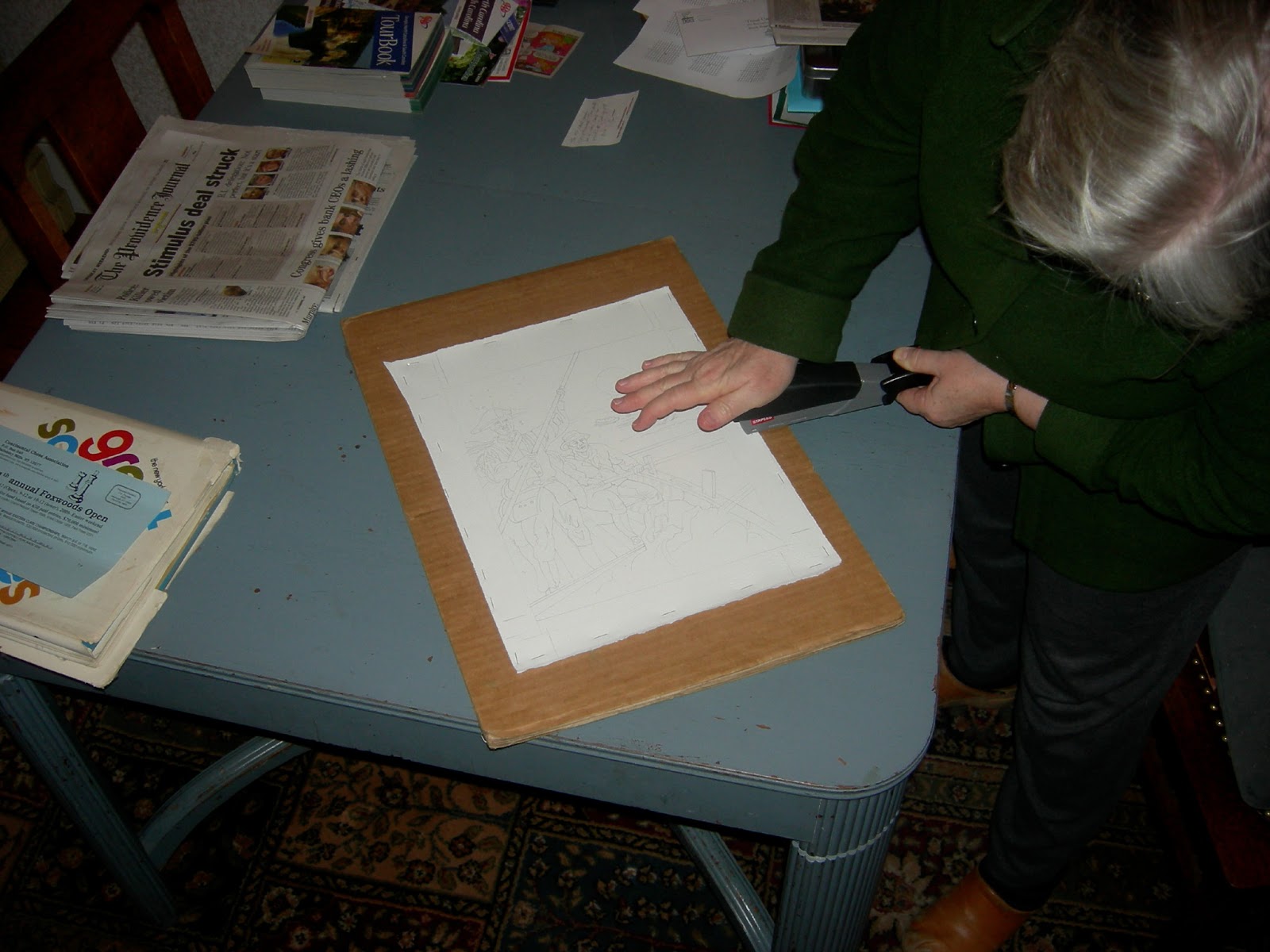
As an illustrator using traditional watercolor techniques, I usually stretch my paper.
Here is a step-by-step tutorial for stretching watercolor paper, and the reasoning behind why I do it.


What is stretching?

Stretching means that you soak your paper and secure the edges so that the paper dries flat and taut, almost like a drum head.

Why stretch watercolor paper?

There are several reasons, but first and foremost is to keep the paper flat. When you wet paper, the fibers expand and the paper warps. The wetter you work, the more your paper will buckle. It's pretty hard to control your paint when it's cascading into a valley.

Even if you stretch your paper, you will have some warping as you work, but the paper will dry flat.

How do you stretch watercolor paper?

I was taught to stretch paper with Masonite and butcher tape, which always ended up as an exercise in frustration for me. (clunky boards and tape that didn't stick) Many years ago, I read an article in HOW magazine that recommended using cardboard and a stapler instead. I've happily followed that technique ever since.

Materials needed:
  • Decent watercolor paper. I use 140 lb. Arches, brilliant white. Fabriano, Strathmore, and Winsor-Newton make good papers, too.
  •  90 lb. paper is too flimsy for serious watercolor work. 
  • 300 lb. paper doesn't require stretching, but it is expensive, and you can't see through it to trace up a sketch, which is a problem for me.  
  • Cardboard. This is tricky. I got some triple corrugated cardboard years ago from Charette, cut it into various dimensions, and it has lasted for twenty years. Sadly, it's now unavailable. Try to find cardboard that's good and sturdy,  and larger than the paper you want to stretch. Chipboard is NOT sturdy enough. Corrugated is good, with no folds. If you have trouble with the cardboard buckling, you can staple two boards together.
  • Stapler.  I use a Staples stapler. Any stapler that you can open flat will work. I don't need an electric stapler.

This is my technique:


I begin by tracing my sketch to the paper before I stretch it. I use a pencil and light-table.

1. Soak the paper.
You can do this in a sink, a bathtub, or a large container. I often softly fold my paper in half so I can use the sink. Whatever vessel you use, make sure it's clean! Watercolor paper is treated with something called sizing. It's purpose is to keep the paper from absorbing too much. You don't want to soak out the sizing, so use cold water, and let the paper soak for a couple of minutes... not more than five.
2. Remove excess water. Pick up the paper by a corner and let it drip, then lay it flat on your board and lightly blot it with a towel.

3. Staple the paper to the cardboard.
I use a regular office stapler that opens flat. Begin with one staple at the center of each side, to make sure you have your paper flat. Then staple about every 2 inches.


4. Leave the board flat until the paper is dry (unless you plan to work wet.) This takes several hours. I usually try to plan ahead so I can leave it overnight. If the paper feels cold to the touch, it's probably still wet, but you can check a corner to see if it's dry enough not to bleed.

Alternatives to stretching.

I find that soaking the paper makes it nicely receptive to washes. However, if you are not using wet washes over broad areas, you may not need to stretch good quality 140 lb. paper at all.
You can also just staple or tape the paper to a board without soaking it, and that will keep the paper relatively flat.
You can use 300 lb paper. No stretching required.
Some illustrators "paint" the back side of you paper with water, then staple it down to a board. That way they can start working right away.

Thursday, March 29, 2012

Illustration Friday # 19: SWAMP

© Cheryl Kirk Noll,  Harriet Tubman escapes slavery
I've been SWAMPed this week with a wonderful weekend conference, a niece getting married, and family visiting from the other coast. So here is an older piece, done for a set of story cards for Graphic Learning, a Divison of Abrams & Co.,  many years ago, illustrating Harriet Tubman escaping from slavery through a SWAMP in Maryland.

Monday, February 13, 2012

Illustration Friday #16: POPULARITY, and Happy Valentine's Day!

"Puppy Love," illustration © Cheryl Kirk Noll

This week's prompt word for illustration Friday was POPULARITY. 

To give myself a little extra inspiration, I found an Aldous Huxley quote: 
 To his dog, every man is Napoleon; hence the constant popularity of dogs.


Puppies and children are high on the popular meter, too... so here is my illustration, done traditionally using watercolors.


And a Happy Valentine's Day to everyone, as well!!!

Thursday, February 2, 2012

Illustration Friday # 15: FORWARD

Am I moving forward today? Sadly, I am posting an older piece. I worked on a new one, but wasn't ready to put it up today. It was similar to this, with snow, and running children and a dog. I did this many years ago, but still love to play with detail against open areas.

I'd like to give credit to fellow illustrator, Marion Eldridge, for moving FORWARD this week by doing a digital piece for Illustration Friday. I, too, am exploring the digital realm, and am impressed with her progress. Love your "baby steps," Marion. Click here to see Marion's post.


They ran FORWARD through the snow. © Cheryl Kirk Noll

Monday, December 19, 2011

Illustration Friday # 9: SINK

The Lion & the Hare

A ferocious Lion who kills for sport, and terrorizes the animals of the forest. Finally, the animals flatter Lion into an arrangement where one animal a day, drawn by a lot, willingly become his supper. In return, Lion agrees to stop hunting.

When Hare draws the lot, he forms a plan. He arrives late, and tells Lion he was waylaid by another Lion.

"In my jungle?" roars the beast. "Take me to him."

Hare leads Lion to a deep well.

Upon seeing his own reflection, Lion roars and threatens the "other" lion. Then, the enraged beast charges at his own reflection, and proceeds to SINK to the bottom of the well, never to be heard from again.

This story is from the Panchatantra, or "Five Chapters," a collection of ancient Indian animal stories, where a wise old man named Vishnusarman uses tales to teach three young princes how to rule wisely.

The story and this illustration can be found in the January 2000 issue of Calliope Magazine, Ashoka, India's Philosopher King. This magazine, geared towards grades 5-9, focuses on World History.
for more information about the magazine, click here.

Friday, December 9, 2011

Illustratin Friday #8: Separated

Loss, from The Crane Wife, illustrations ©Cheryl Kirk Noll
The Crane Wife is a well known Japanese folktale. It begins as a story of love and caring, when a poor woodcutter saves the life of an injured Japanese crane. Good fortune follows,  but he allows greed and pride to overcome compassion and thankfulness. 

Thus, he is separated from what he holds dear.

 © illustrations by Cheryl Kirk Noll, The Crane Wife, by Ena Keo
I'm thankful that I was asked to illustrate this story early in career.  
The book includes a few images that are still among my favorites.

Saturday, December 3, 2011

Illustration Friday #7: BRIGADE, and What I Learned While Researching the Black Regiment


Brigade: A military unit consisting of a variable number of combat battalions or regiments
Battle of Rhode Island, Revolutionary War,  © Cheryl Kirk Noll

Since I had the good fortune to work with RI author Linda Crotta Brennan on a book called The Black Regiment of the American Revolution a few years ago, I'm using one of the images from the book for the prompt "brigade." These paintings were done using traditional watercolor techniques.


I also decided to post about a few things I learned while researching this fascinating subject.

Linda Crotta Brennan gathering information at the reenactment of the Battle of RI.


The book is about a RI Revolutionary War regiment that was comprised of men of color. In 1778, the Rhode Island legislature passed a law that created what was later to be called the Black regiment. "Every able-bodied Negro, mulatto, or Indian man-slave" could enlist. The state would pay owners for their slaves and those who  enlisted would be given the same "bounty and wages" as White soldiers. If they survived the war, they would earn their freedom. Close to 200 men signed up. Most of them served until the war ended.

Here are some of the things I learned. 

1. RI had slaves. 

From "The Black Regiment of the American Revolution," ©Cheryl Kirk Noll
Newport was major port, and a hot spot in the slave trade. 

Rhode Island did not abolish slavery until 1784, a year after the Revolution ended. However, they didn't actually free those who were currently slaves. They freed children who were born after that date, but not until they turned a certain age; 21 for males, 18 for females. 

The last slave in Rhode Island died in 1859, just four years before Lincoln's Emancipation Proclamation. 


Some of the men who fought in the Black Regiment:Primus Brown, Cuff Greene, Jacob Hazard, Ebenezer Mumford, Prince Vaughn. From the muster rolls at the RI Historical Society 


2. Reenactors are knowledgeable and generous folk. 

I was incredibly lucky while researching this book to have the Battle of RI (featured in the book) reenacted in Portsmouth, RI. Over 1,000 men, women and children appeared in authentic costume, set up camp and reenacted the battle.


I talked to many of the participants, and was impressed with the amount of research they had done to be historically accurate. 

My illustrations were also reviewed by RI reenactors, who pointed out fine points, like the difference between tricorns and bicorns, and the importance of having straps strong enough to support heavy ammunition bags. 

Many, many thanks go to them.


Comments on my sketches from RI reenactors.


 3. History is subjective.
Linda and I came across a quote about a skirmish in New York state with a group of loyalists called Delancey's Tories, where Colonel Christopher Greene was killed. It said: "the sabers of the enemy only reached him through the bodies of his faithful guard of Blacks, who hovered over him to protect him and every one of whom was killed." That quote was in dozens of books. 

I wanted to find out what the place looked like for my illustrations, so I went to the Yorktown Museum in Yorktown Heights, NY, http://www.yorktownmuseum.org/ where they had some primary source documents about the skirmish. These  included a loyalist newspaper account, and a document  by a woman who was a child living in the house at the time of the attack, written when she was an old woman. The accounts were different, and neither mentioned the "faithful guard...every one of whom was killed." 

It was an "aha" moment for me. We don't really know exactly what happened, and we never will.

The unit that Greene was commanding was definitely integrated. There is evidence that some black soldiers were captured and sold back into slavery. Maybe the author of the statement had additional information available, but the statement seems woven with a bit of supposition. It really made me think.

4. People of color have been full and active participants in the United States from the get-go. 

This is a ridiculously simple-minded conclusion. Of course, Native Americans were here before Europeans. Long before! But did you know that by many accounts, 1 of 6 men who served in the Revolution were men of color? That Americans enslaved Native Americans in states such as RI? That there were Blacks in Jamestown in 1690? That initially slaves/servants were able to earn their way out of slavery and purchase property, but one by one, laws were passed to revoke these rights for Blacks. Eventually, laws were passed in some places to prevent owners from freeing their own slaves without getting permission from the state.
I discovered so many things that no one taught me in school. I felt amazed, a little embarrassed by my lack of knowledge, and a little angry with simplistic, white-washed educational texts.


5. Rhode Island is a spectacularly beautiful state. 

Of course, I live here, but I really began to appreciate it when I went looking for battlefields, historic societies and armories.


"The Black Regiment of the American Revolution" is still in publication.  It is geared for readers between 8-12. It can be purchased at Apprenticeshop Books, Ltd. Click Here
"The Black Regiment of the American Revolution," by Linda Crotta Brennan, illustrations by Cheryl Kirk Noll 


The story of the men who fought for freedom, both their country's and their own, makes for fascinating reading.


Wednesday, November 30, 2011

Illustration Friday #6: ROUND


I'm putting up an older piece for this week's Illustration Friday prompt, ROUND. I have so many... round moons, round suns, round the campfire... but I chose a holiday image of children dancing 'round the tree. When I painted this (watercolors and colored pencil), I called it "Dancing with the Stars."
Now that a fun, family Thanksgiving has come and gone, I'm trying to move on to the the next holiday.

Monday, October 24, 2011

Illustration Friday #5: FUEL

I didn't have time to do a new piece for Illustration Friday this week, so I'm putting up an older piece that illustrates a legend about the goddess Pele, from Hawaii. This is done traditionally, using watercolors.


The taunts from her sister only fueled Pele's anger.